The Shooting Party: Britain's Informal Seat of Power
In the decade before the war, the country-house shooting weekend was not merely recreation. It was where British policy was formed, where alliances were cemented, and where the conversations that no minute-taker was ever invited to record took place. For those with the right to be there, it was the most important room in England. For those who served it, it was something else entirely.
The pheasant shoot was, by the early twentieth century, an institution as ritualised as Parliament and considerably more candid. The great houses of England — Chatsworth, Blenheim, Petworth, Knowsley, Longleat — hosted shooting weekends from October through February in which the guest lists mapped the architecture of British power more accurately than any Cabinet reshuffle. Cabinet ministers, newspaper proprietors, industrialists, foreign ambassadors and members of the royal household moved through the same shooting parties each season, their conversations unminuted, their relationships unmapped by any official record.[1]
The formality of office was left at the gate. A man who could not be seen entering another man's club might stand next to him at a peg on a Berkshire hillside for six hours without remark. The sport was the pretext. The conversation was the purpose. And the conversations, overheard by those whose job it was to be invisible — loaders, keepers, beaters, the men who managed the dogs — were the most unguarded in England.
How a driven shoot works: the mechanics of the day
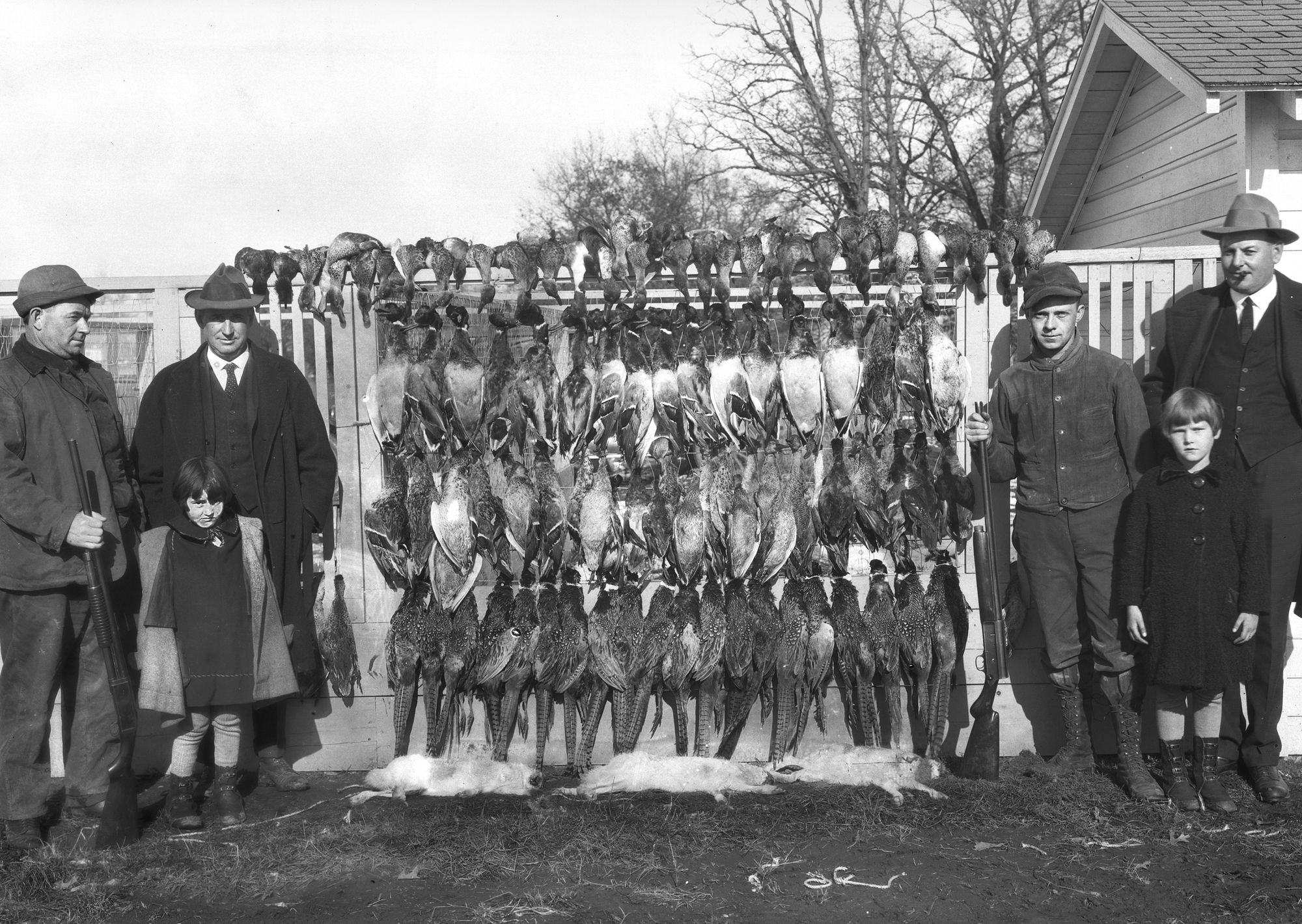
For those unfamiliar with the sport, the architecture of a driven pheasant shoot is worth understanding, because it determines everything about the social dynamics of the day. A driven shoot differs from walked-up shooting in a fundamental way: in a driven shoot, the quarry comes to the Guns rather than the Guns going to the quarry. It is this reversal that makes it both the more challenging form of the sport and the more socially loaded.
The Guns — typically eight to ten on a formal day — are positioned at numbered pegs along a line below the cover. The beaters, a larger party of men and sometimes women employed for the day, move through the woodland above, driving the birds forward over the line. The pheasants, pushed from their cover, take flight toward the open ground ahead of them — and find themselves above the Guns. The distances and angles at which they arrive determine the difficulty of the shot.
- The peg
- A numbered marker in the ground at which each Gun stands during a drive. Pegs are positioned along the line by the head keeper, their spacing and angle determined by the topography of the drive. A good peg on a good drive is a coveted position.
- The drive
- A single organised movement of birds over the line. A full day's shooting typically comprises four to six drives, each in a different part of the estate. Between drives, the Guns walk or are driven to the next location.
- The loader
- A man employed to stand alongside a Gun and reload between shots, allowing continuous shooting during the height of the flush. A skilled loader is an operational partner as much as a servant — he manages the guns, tracks the birds, and by long tradition says nothing unless asked.
- The beating line
- The party of beaters advancing through the cover. They use sticks and flags to move the birds forward, calling and tapping to keep them moving. The head beater controls the pace and direction of the line, communicating with the keeper by whistle.
- The flush
- The moment when a large number of birds leave the cover simultaneously, producing a concentrated period of intense shooting. The height of the flush lasts minutes. It is what the entire apparatus of the day is constructed to produce.
- The game cart
- A horse-drawn or motorised vehicle that follows the shooting day, collecting the fallen birds from each drive. The day's total — recorded in the game book — is a measure of both the quality of the shoot and the effectiveness of the Guns.
- Right-and-left
- Two consecutive shots on two different birds, one taken to the right and one to the left (or vice versa), both achieved with the same gun before reloading. A clean right-and-left on high birds is considered one of the finer achievements of the sport.
The shot itself — on a high, driven pheasant — is a considerably more demanding exercise than it appears to the uninitiated. The birds, using the wind and their own momentum off the high cover, arrive fast and at angles that require the Gun to calculate distance, speed, height, and crosswind simultaneously, swinging through the line of the bird and firing in the moment of overtake rather than at the bird itself. It is a sport that rewards practice and punishes hesitation. A man who shoots well tells you something about how he was formed; a man who shoots badly under scrutiny tells you something about how he responds to pressure.
Albert Ernest Collings, the taxidermist and loader at the centre of this story, had spent thirty years reading both.
"He did not find these men interesting as a class. He found them interesting as a source of information, which was a different thing entirely."
The information architecture of the shooting party
Lord Beaverbrook, writing to a colleague in 1931, described the shooting parties as "the only place where one hears what is actually to be decided, as opposed to what is to be announced."[2] The comment was not cynical — it was accurate. The decisions taken at Chatsworth in November 1937, in a conversation between Halifax and his German visitors, did not appear in any diplomatic record.[3] They were not meant to.
The political significance of this informality was well understood at the time. Cabinet decisions required minutes. Parliamentary speeches entered Hansard. Diplomatic dispatches went into the Foreign Office files. But a conversation at a peg between the fourth and fifth drives, the beaters still moving through the cover above, with only the loader at the left shoulder and the dog working the ground behind — that conversation existed in no record at all, unless someone was specifically engaged to remember it.
The house at Mereworth Castle in Kent occupied a particular position in this network. The estate was large, the shooting excellent, and the guest lists for January 1929 — the last shoot of a season that would end with Churchill losing the chancellorship in the May election — included names that would not appear together in any official context for another decade. Londonderry. Halifax. Several men whose relationship with Germany's new politics was, at that stage, described as sympathetic understanding rather than collaboration. What was said there was not recorded. What was heard there, by those whose job it was to listen, is a different matter.
The loader's position: invisible, essential, and everywhere
The loader occupied a unique position in the social geography of the shooting party. He stood within arm's reach of the Gun throughout the drive — closer than a secretary, closer than a valet — and was by convention neither seen nor heard. He handled the guns: receiving the fired weapon, reloading from the cartridge bag at his feet, and returning the loaded gun to the Gun's hands within two or three seconds. He watched the line for birds, tracked the fall of shot game, and managed the logistics of the Gun's position throughout the drive.
He heard everything. This was not accidental. The convention of the loader's silence was not rooted in contempt but in function: a loader who commented, who reacted, who allowed his personality into the space between shots, was a distraction. The good loader was air. And air, as any architect of surveillance eventually learns, carries sound in all directions.
Between drives, walking to the next stand, the social architecture shifted. The Guns talked among themselves, moving in pairs or small groups, the loaders falling in a few yards behind. The conversation at these moments — relaxed by the morning's shooting, warmed by the physical work of the drives, freed by the distance from London and the absence of any formal setting — was different from the conversation of offices and clubs. Men said what they thought. They named what they were afraid of. They described the arrangements they had made or were considering.
Albert Ernest Collings had been loading at Mereworth for twenty-nine years by the time Winston Churchill drew the peg at five on the morning of January 1929. He had stood beside lords and generals and ministers and on one occasion a minor European royal whose shooting he remembered and whose name he had immediately forgotten. He did not find these men interesting as a class. He found them interesting as a source of information, which was a different thing entirely.
From the novel: the first drive at Mereworth, January 1929
The morning had started cold and bright, the frost still on the grass when the Guns drew for pegs at eight o'clock. Eight guns for the last shoot of the season, assembled in the hall of Mereworth after the drive down from London the night before — the champagne, the dinner, the talk about the markets and the election and who was going where in the reshuffle. Albert had been helping in the boot room from six. He heard most of it.
The peg draw put Churchill at five. Albert fell in at his left shoulder, the bag at his feet, the two Woodwards broken and comfortable in the crook of his arm. They were fine guns — matched pair, twelve-bore sidelocks, built by James Woodward and Sons of St James Street to Churchill's measure, the stocks cast and extended for a man who was broad across the chest and carried his weight forward. Albert had handled a great many guns in his time and he could read a man's shooting before the first drive began by the way he took the gun from the slip and settled it into the mount. Churchill settled it well. He had been shooting all his life and it showed in the hands — the left arm easy, the right elbow not too high, the gun coming to his face rather than his face dropping to the gun.
He was overweight and knew it and did not discuss it. He was fifty-four years old, four months from losing the chancellorship on a government's defeat, and he had the look of a man running on stubbornness and good claret and the knowledge that he was right about things nobody wanted to hear him being right about.
The beaters went in. The horn sounded. The first birds came.
They came off the ridge in the way they always came in January — high and fast, using the wind, curling left as they broke from the wood and turning back for the home covert when they found open sky. Albert watched Churchill's gun. He was accurate on the incomers and very accurate on the crossing birds going right. He was less certain on the high birds directly overhead, which was a matter of weight and fitness — the gun was getting to his face a fraction late. Albert filed this as information about timing and reloaded without drawing attention to it.
What happened between the drives: the conversation that changed everything
Between the first and second drives at Mereworth, Churchill walked the path along the bottom of the valley at Albert's shoulder rather than with the main party. This was a preference rather than an accident. A man who chooses to walk with his loader rather than with the other Guns is making a calculation about where the useful conversation is to be found.
"Tell me something," Churchill said, without preamble. "You've been working this estate for how long?"
What followed was not a recruitment in any formal sense. There were no documents. There was no arrangement. There was a question, and an answer, and the recognition — on both sides of a very considerable social distance — that what Albert Ernest Collings had been accumulating for twenty-nine years in the rooms and fields of the English establishment was, in the right hands, of considerable value.
The three brothers were on the beating line that morning. That detail is not incidental. Albert had arranged it through the head keeper, Caxton. Geoffrey, the eldest, was working the retriever behind the Guns' line. Reg and Cyril were in the cover above, indistinguishable among the beaters at that distance, present in the machinery of the day without being visible as themselves. They were thirteen and seventeen and fifteen years old. They had been doing this, in various forms, since they were old enough to walk a straight line through a wood.
Churchill, who was a man who listened carefully to silence, heard all of this without being told any of it. By the time the horn sounded for the second drive, something had been decided that would take twelve years to complete.
The shoot at Mereworth that January was, by the standards of the great estates, a modest affair. Eight Guns, four drives, a total of just under six hundred birds on the game cart. By the standard of what it set in motion, it was rather more significant. The conversation between Churchill and Albert at the edge of the lower wood lasted perhaps ten minutes. It produced no document, no arrangement, no record of any kind.
What it produced was a question, and an answer, and an understanding between two men that the information available to one of them was of value to the other, and that there were ways of making it useful that did not require either of them to appear in any official account of anything.
Three boys on a beating line in a Palladian estate in Kent. A man with a gun and a man with a bag and twenty-nine years of things overheard. And a decision taken between the first and second drives of the last shoot of the 1929 season that would put Cyril Bacon in a field in Ayrshire on the night of 10 May 1941, waiting for the sound of a Messerschmitt approaching from the north-west.