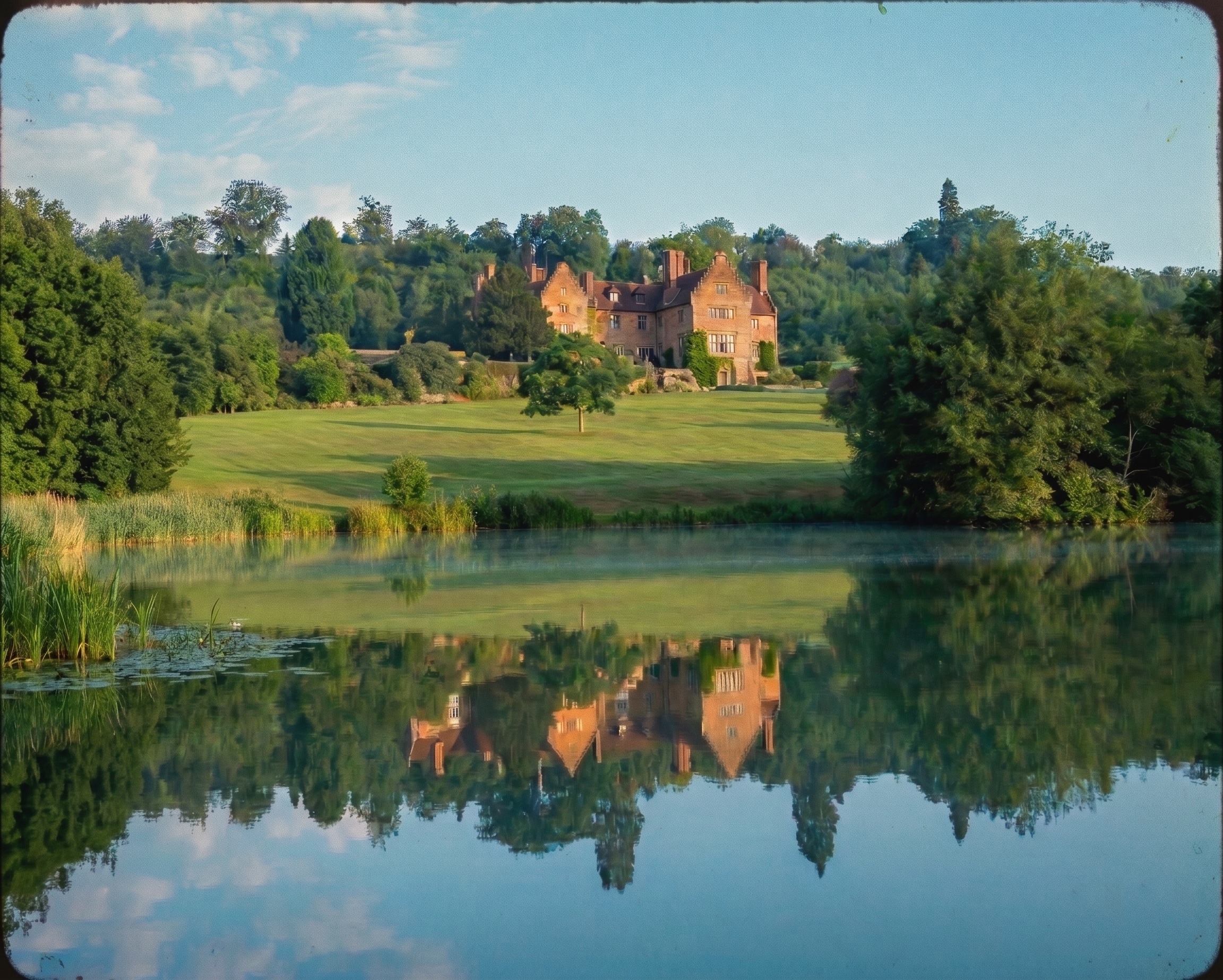
Chartwell
Churchill's house — and the lake the title comes from.
Winston Churchill bought Chartwell, near Westerham in Kent, in October 1922 for £5,000, and undertook substantial alterations to the house through the 1920s under the architect Philip Tilden, before settling there with his family in 1924.[1] It remained his home through the wilderness years of the 1930s — the period in which he held no government office, was widely regarded as a spent political force, and devoted himself to the house, its gardens, and the lake he had the valley below it bulldozed to create.
The lake is not large, perhaps a hundred metres at its longest point, but its far bank has one property the house itself does not: open ground, with a clear sightline back to the house and along the water in both directions, where a conversation cannot be overheard and anyone approaching can be seen from a considerable distance.[2] Churchill's telephone lines were tapped after Munich, on the instruction of Sir Joseph Ball, and the transcripts passed to Neville Chamberlain — a documented fact, confirmed in postwar accounts of Ball's intelligence activities. His post was intercepted at the Mount Pleasant sorting office. A guest who visited Chartwell in October 1938, the Foreign Office official Guy Burgess, was — unknown to Churchill at the time — passing everything he heard there directly to Soviet intelligence.
The one place at Chartwell where no wire could reach and no lip-reader could observe — the far bank of a lake Churchill built with his own hands.
Morton came across the fields, as he always did, and Churchill was waiting for him on the far bank with his hands behind his back, looking at the water, and neither of them spoke until Morton had crossed the whole distance and stood beside him.