The Messenger Economy: How London Moved Information Before the Telephone
Before secure telephone lines, before telex, the City of London ran on human runners. Boys as young as thirteen carried documents between banks, brokerages and government offices — invisible to the people they served, privy to everything they carried.
In the second half of the 1920s, the financial heart of London still moved largely as it had moved for the previous fifty years: on foot and by bicycle, carried by boys in uniform caps employed by district messenger companies that contracted their services to banks, brokerages, law firms, and government departments.[1] The telephone existed, but trunk lines were unreliable and a great deal of City business — share certificates, contract notes, sealed correspondence between institutions that did not trust the post — still moved by hand. A boy of thirteen or fourteen, in a peaked cap and a company-issue jacket, was as common a sight on the streets of the Square Mile as a delivery dray, and very nearly as invisible.
The boys left school at thirteen, the legal minimum, and the district messenger services were one of the few employers willing to take them straight away.[2] The work paid poorly but it placed a working-class boy inside institutions he would otherwise never enter — the marbled banking halls, the panelled boardrooms, the kitchens and service corridors of the great hotels and gentlemen's clubs that did business with the firms he served. He came and went through tradesmen's and service entrances. Nobody minded what he overheard, because nobody imagined he was capable of understanding it, or interested in it, or going anywhere with it.
What the messenger boy carried, he generally could not read — sealed envelopes, wax-stamped pouches, instructions to deliver to a named individual and no other. But he moved through spaces where information leaked constantly in less formal ways: kitchen gossip about who had lost money at the races, which minister was overextended at his club, which lord's marriage was in difficulty. None of it was secret in the sense of being classified. All of it was the kind of social intelligence that, gathered patiently and cross-referenced over years, told you a great deal about who could be relied upon, who could be pressured, and who already owed somebody a favour they had not yet been asked to repay.
"Invisible to the people they served, privy to everything they carried."
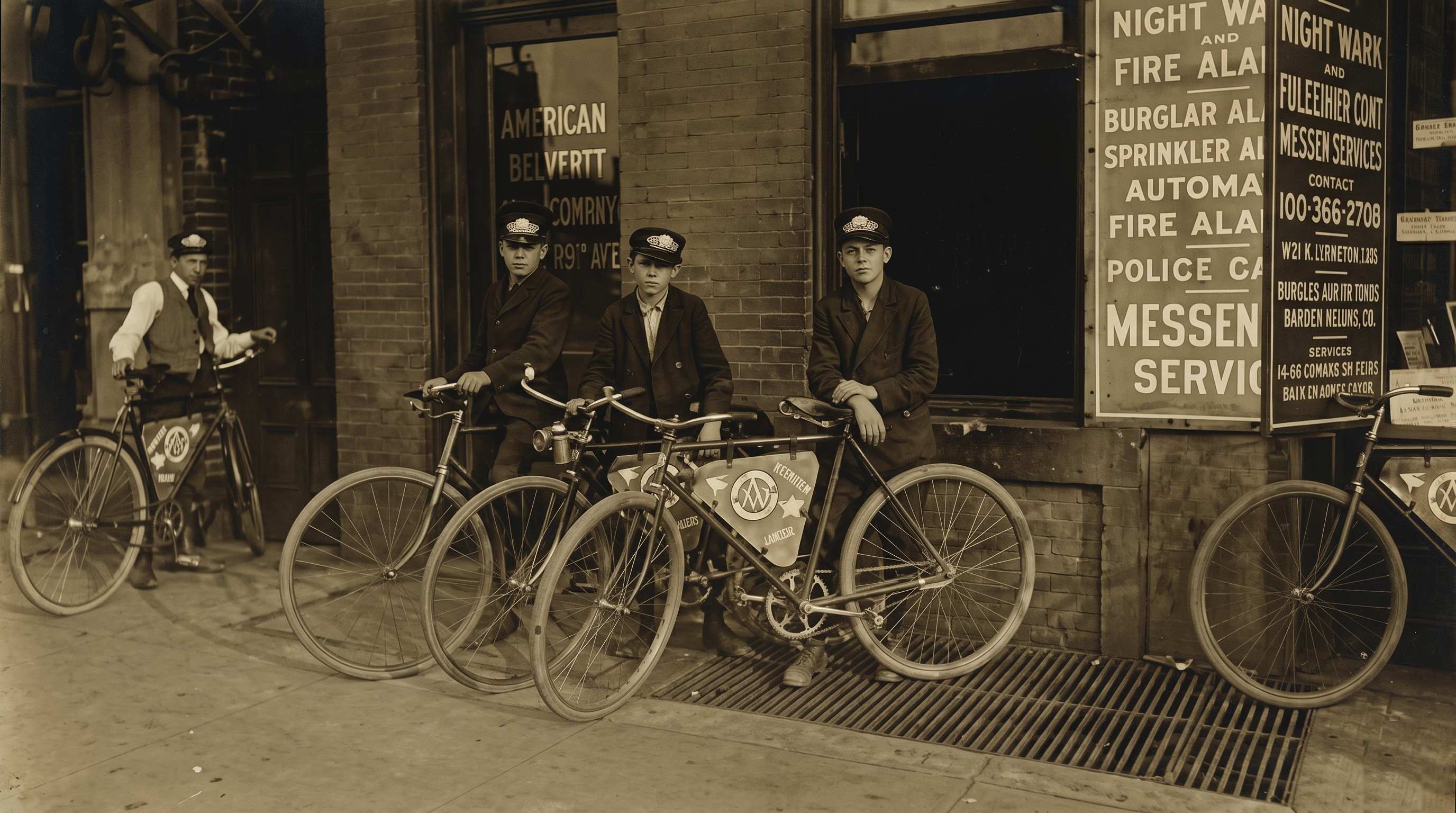
It is documented, separately, that more than one informal surveillance and intercept operation in this period used exactly this workforce as an unwitting or semi-witting collection layer — boys on established routes, pulled aside occasionally, message pouches opened and resealed, notes copied before delivery.[3] A messenger who worked the same routes for two or three years became a known and trusted fixture, the kind of person a more senior operative could approach with a small, specific, repeatable request, made to sound like nothing at all. The family's account holds that two brothers from a Kent farming family entered exactly this world as district messengers in the mid-1920s, and that what began as a casual approach from an older boy on the same routes became, within a few years, something considerably more deliberate.
Jack had worked the route for two years longer than Reg had, and he said it the way you might mention the weather. If you ever get a message for the boss, he said, the boss likes to see it first. Before it's delivered. He'll make it worth your while.
He did not say who the boss was. Reg did not ask. That, he understood later, had been exactly the point.