The Sunderland Flying Boat: Britain's Long-Range Eyes Over the Atlantic
The Short S.25 Sunderland entered RAF service in 1938 as one of the most capable maritime patrol aircraft of its era. Powered by four Bristol Pegasus radial engines, it could remain airborne for thirteen hours and operate at extreme range from conventional airfields — because it did not need one.
The Sunderland's defining feature was the one its name does not advertise: it was a boat as much as it was an aircraft. Developed from the Short Empire flying boats that had carried passengers and mail across the Empire's air routes through the 1930s, the Sunderland could take off and land on open water, which meant it required no conventional runway and could be based wherever there was a sufficiently large, sufficiently sheltered stretch of sea or loch.[1] In the context of Scotland's north coast — Caithness, Orkney, the sea lochs of the western Highlands — this was the aircraft's central operational virtue. A flying boat could be based at a remote loch with no airfield infrastructure at all, refuelled from a depot ship or shore tanks, and sent out on patrols lasting most of a day.
| Manufacturer | Short Brothers, Rochester, Kent |
| Entered service | 1938 |
| Engines | 4 × Bristol Pegasus XVIII radial |
| Crew | typically 9–11 |
| Endurance | up to 13 hours |
| Range | approx. 1,780 miles (2,865 km) |
| Cruising speed | approx. 178 mph (286 km/h) |
| Role | Maritime reconnaissance, anti-submarine patrol, VIP transport |
Operationally, the Sunderland's primary war role was anti-submarine and maritime reconnaissance patrol over the North Atlantic, where its long endurance made it invaluable for shadowing convoys and hunting U-boats.[2] Its size and range also made it a natural, if unglamorous, choice for moving senior personnel over long distances where a conventional landplane could not easily reach — including, on occasion, members of the Royal Family and other VIPs travelling to and from Britain's more remote northern and overseas stations.
An aircraft built to need no runway at all — which made it, by the same logic, an aircraft that could depart from almost anywhere, watched by almost no one.
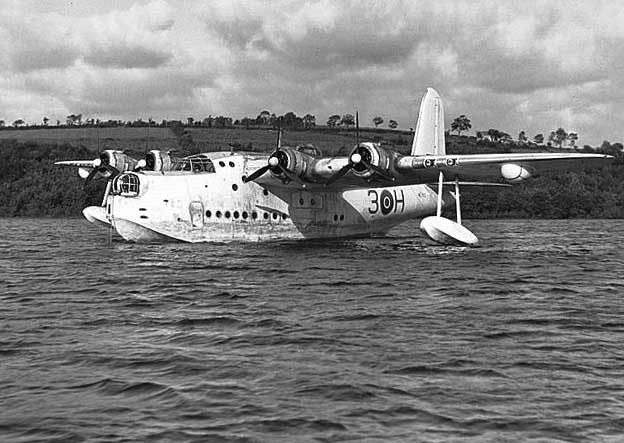
The Sunderland remained in RAF service well beyond the war, continuing in maritime patrol and search-and-rescue roles into the 1950s, a testament to the soundness of the original design. Its wartime record as a U-boat hunter and long-range patrol aircraft is well documented. Its occasional use for the movement of senior figures along routes that did not require a fixed airfield is the less remarked-upon side of the same capability — and the side that places it, on a clear August afternoon in 1942, somewhere it was not supposed to be.
The aircraft sat on the loch like something that had always belonged there, low and grey and enormous, and Cyril thought, not for the first time, that the things meant to be invisible were very often simply too large to be questioned.