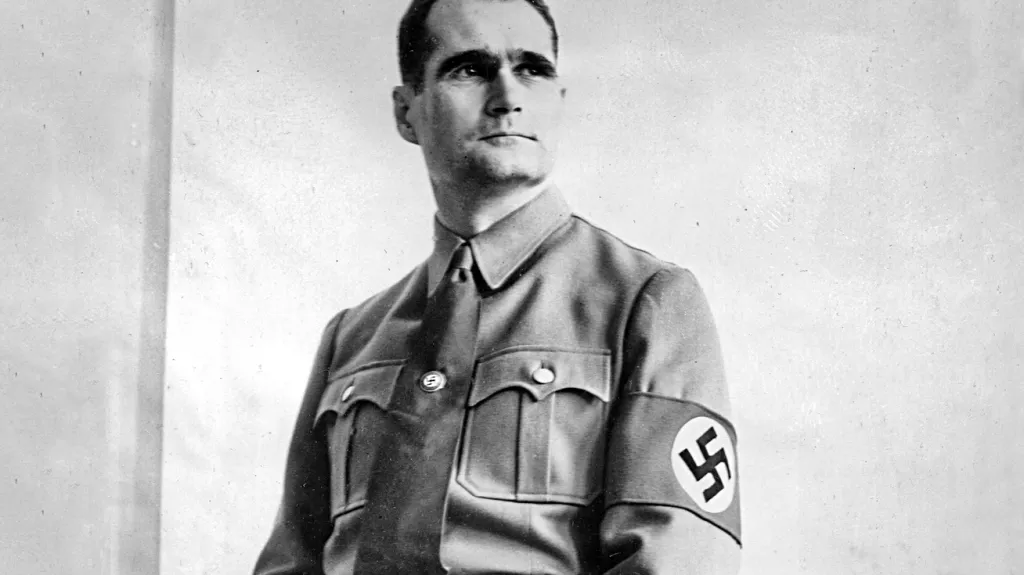
Rudolf Hess joined the Nazi Party in 1920 and rose to become Adolf Hitler's deputy and one of the most senior figures in the German state, designated by 1939 as second in the line of succession after Hermann Göring.[1] By the spring of 1941 his political influence had waned considerably relative to rivals such as Göring, Goebbels and Bormann, and it is in this context — a man of formal seniority but diminishing real power, increasingly preoccupied with the war's trajectory and Germany's relationship with Britain — that he undertook the act for which he is now principally remembered.
On the night of 10 May 1941, Hess took off alone from Augsburg in a Messerschmitt Bf 110 and flew to Scotland, parachuting to safety near Eaglesham after running low on fuel.[2] He gave his intended destination, on capture, as Dungavel House, the Ayrshire seat of the Duke of Hamilton — a man he had never met but believed, on the strength of intermediary contacts made through his foreign-policy adviser Albrecht Haushofer, might be receptive to a German peace overture. He was arrested within hours and held for the remainder of the war, and the remainder of his life, in British and then Allied captivity.
Captivity
Hess was held initially at Mytchett Place near Aldershot, under the cover designation Camp Z, before being transferred to Maindiff Court Military Hospital near Abergavenny in June 1942, where he remained for the rest of the war.[3] The documentary record of his captivity contains a number of well-attested oddities: a War Office medical officer's diary entry from June 1942 records that Hess believed he was being poisoned and requested that samples of his food and vitamins be sent for independent analysis. He arrived in Britain a committed teetotaller and vegetarian and, at points during his captivity, departed from both — a change in personal habit that has never been satisfactorily explained on the documentary record alone.
At Nuremberg in 1945–46, Hess presented as erratic, at times claiming amnesia about his own past, and was the subject of extensive psychiatric assessment by the tribunal. He was convicted of crimes against peace and sentenced to life imprisonment, served almost entirely at Spandau Prison in Berlin, where — following the deaths of his co-prisoners — he became, for the last two decades of his life, the institution's sole remaining inmate.
A man who arrived in Britain believing himself the last rational actor capable of ending a war — and who spent the next forty-six years unable to convince anyone, including, by the end, himself.
What the official record does not and cannot explain is who Hess was speaking to, and for how long, in the eighteen months before his flight — nor what passed between him and the men assigned to guard him in the years that followed. That space, between the documented fact of his flight and the undocumented texture of his captivity, is where this novel's account of Hess begins.
Hess asked the question in German, quietly, the way a man asks something he has already decided he knows the answer to.
"Are you one of them?"
Cyril did not answer immediately. He had been thinking, for eighteen months, about exactly how he would answer this question when it finally came.