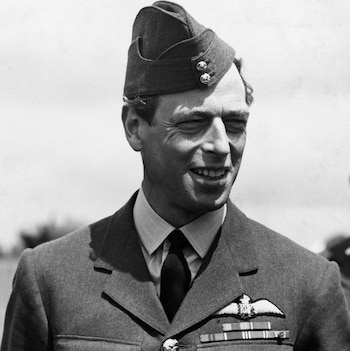
Prince George, Duke of Kent, was the fourth son of George V and Queen Mary, and the most personally complicated of the royal siblings.[1] He had trained as a naval officer, then moved to the Foreign Office, then — following the abdication crisis and the reorganisation of royal duties it necessitated — into an active role with the Royal Air Force.[2] By 1941 he held the rank of Air Commodore and was undertaking official tours and welfare inspections on behalf of the RAF across Britain and the Commonwealth. He was widely regarded as the most intellectually able of the Windsor sons, and the one whose sympathies before the war had most clearly included sympathy for Germany — a country whose royal families were his cousins, and in which he had spent considerable personal time during the 1930s.
He was married to Princess Marina of Greece and Denmark. They had three children. On the morning of 25 August 1942, he kissed them goodbye at Coppins, his home in Iver, Buckinghamshire, and left for an official RAF trip to Iceland.[3] He did not reach Iceland.
The crash at Eagle's Rock
Short Sunderland flying boat W4026, of 228 Squadron RAF Coastal Command, departed from Loch More in Caithness at approximately 13:10 on 25 August 1942.[4] Fifteen people were aboard, including the Duke of Kent. The aircraft was scheduled to fly to Iceland — the standard northern patrol route, up the east coast of Scotland and across the Atlantic. Instead, it turned south-east almost immediately after take-off and flew at low altitude across the Caithness moorland. At approximately 13:30 it struck the hillside above the Berriedale Water gorge at Eagle's Rock, killing fourteen of the fifteen people aboard. The sole survivor, tail gunner Andrew Jack, was found unconscious some distance from the wreckage.
The inquiry, conducted under Air Vice Marshal Sir Philip Babington, concluded that the most probable cause was an error of navigation — the aircraft had descended too soon, possibly because of a faulty altimeter reading or confusion about the terrain ahead.[5] The inquiry noted that the weather conditions were clear, the crew experienced, and the aircraft in good mechanical order before departure. It did not explain why an aircraft bound for Iceland — whose correct heading from Loch More is approximately north-west — was flying south-east.
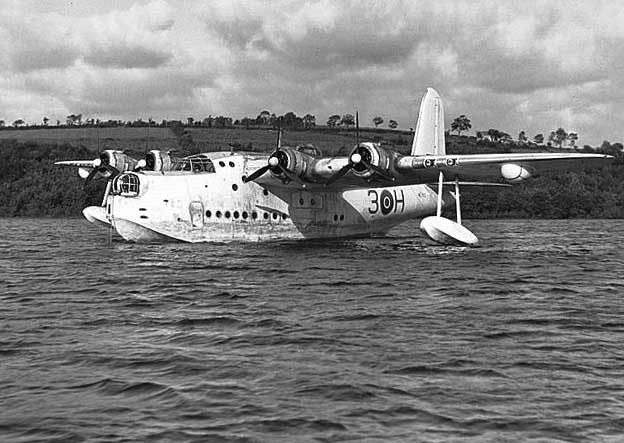
"The inquiry was unable to account for the deviation from the planned route. Its final report stated that the cause could not be determined on the available evidence."
The Duke of Kent was, at the time of his death, the most senior member of the Royal Family to die on active service since the medieval period.[6] His death was announced to the public the following day. The circumstances — a daylight crash in clear weather, flying in the wrong direction, at an elevation the aircraft should easily have cleared — were noted at the time and have been examined by researchers, historians, and aviation investigators in the decades since. No explanation has been formally accepted.
He is buried at St George's Chapel, Windsor. The memorial at Eagle's Rock, a flat stone inscribed Hic Mortuus Est, is on the hillside above the Berriedale Water. It is accessible by a rough track from the A9.