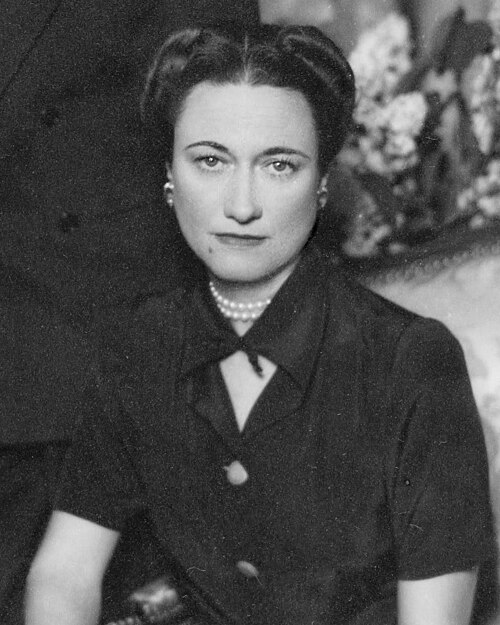
Bessie Wallis Warfield was born in Blue Ridge Summit, Pennsylvania, in 1896, and married for the first time at twenty years old.[1] By the mid-1930s she was living in London, separated from her second husband Ernest Simpson, and had become the close companion of the Prince of Wales — a relationship that was, by 1935, the most important political secret in the British establishment. Intelligence services in three countries were paying attention to who she saw and what was discussed in her drawing rooms.
Her flat at Bryanston Court, Mayfair — a well-appointed address a short walk from Marble Arch — was, between 1935 and 1936, one of the most closely observed private addresses in London.[2] Special Branch filed regular reports on her visitors. MI5 had sources in her domestic staff. The German Embassy was in contact with her through channels that the Foreign Office was aware of but did not fully control.
Ribbentrop and the carnations
Joachim von Ribbentrop, then German Ambassador to Britain, was a regular caller at Bryanston Court during 1936.[3] The relationship between Ribbentrop and Wallis Simpson has been the subject of considerable historical speculation, and the documentary record is incomplete by design: neither party had an interest in candour, and the files that might have resolved the question have either been closed or destroyed.
What is documented is that Ribbentrop sent flowers to Wallis Simpson on multiple occasions — the carnation bouquets are mentioned in several contemporary accounts and in the diary of one of Wallis's friends, who noted their regularity and their extravagance.[4] Carnations were a specific choice: they were associated with German diplomatic protocol in a way that roses, for instance, were not. The precise number of bouquets and their contents are not established in any document that has been released.
After the abdication, Wallis and the former king — now Duke of Windsor — visited Germany in October 1937, toured armaments factories, and met Hitler at Berchtesgaden.[5] The German government's own records of the visit describe the Duke as believing that he could have prevented the war, and as prepared to support a negotiated settlement that would have restored him to influence if not to the throne. Wallis's own position in these conversations is not recorded separately from her husband's.
She outlived the Duke by fifteen years, dying in Paris in 1986. She left few papers of historical value. Her florist — a young woman from Kent who had trained at Constance Spry's establishment in South Audley Street — noticed something inside one of the carnation bouquets that she did not understand. She showed it to her father. What happened after that is a matter of record elsewhere.