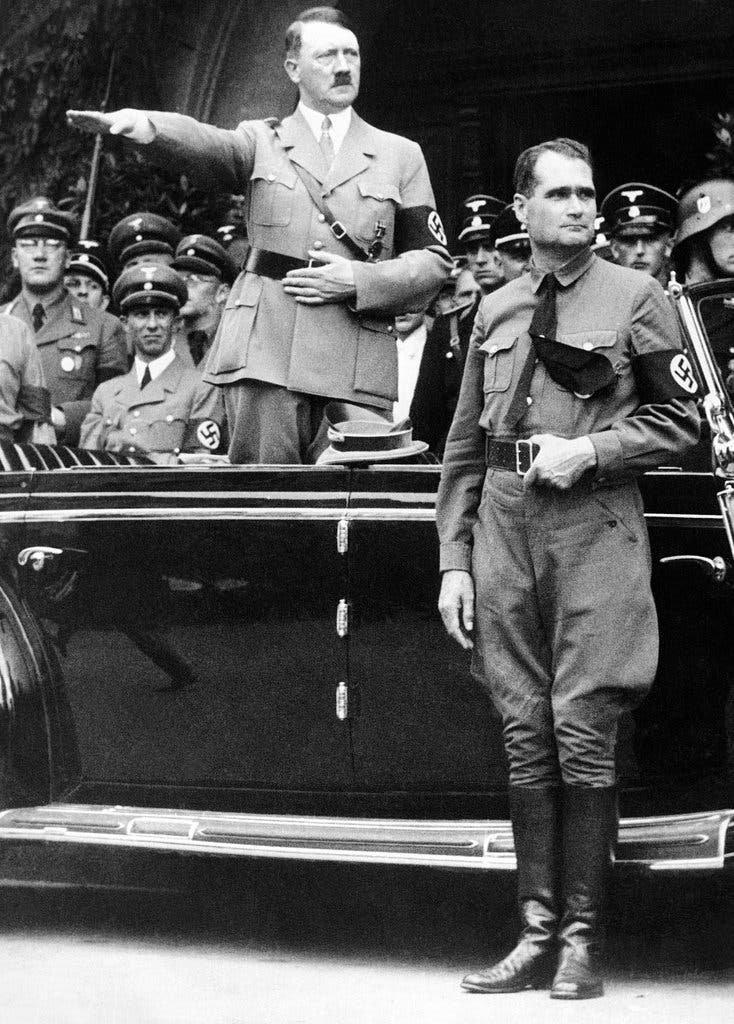
On the evening of 10 May 1941, Rudolf Hess — Deputy Führer of the Third Reich, second in the Nazi hierarchy only to Hitler himself — climbed alone into a Messerschmitt Bf 110 at Augsburg-Haunstetten airfield and flew north-west toward Scotland.[1] He had been planning the flight for months. He had modified the aircraft himself, adding auxiliary fuel tanks to extend its range. He had studied meteorological reports, plotted his course with care, and briefed no one in the German government.[2] At approximately 23:09, he parachuted from the aircraft at around 6,000 feet over the Renfrewshire hills. The aircraft crashed near the village of Eaglesham. Hess was captured by a Home Guard farmer named David McLean, who thought he was a Luftwaffe pilot who had bailed out after a bombing raid.
Hess asked to be taken to the Duke of Hamilton. He said he had an important communication for him. He said his name was Alfred Horn.[3]
Why the Duke of Hamilton?
The Duke of Hamilton — Wing Commander Douglas Douglas-Hamilton, 14th Duke — was a decorated RAF officer, the first man to fly over Everest, and a member of the inter-war Anglo-German Fellowship.[4] He had met Hess in Berlin in 1936, at the Olympic Games. This was the connection Hess was pursuing: a senior British aristocrat with royal access and documented sympathy for the idea of an Anglo-German understanding.[5]
Hamilton denied any prior knowledge of the flight. MI5 investigated him and concluded there was no evidence of collaboration.[6] Whether that conclusion was correct, or whether it was the conclusion that best served the interests of those conducting the investigation, has been debated since 1941.
What is documented is that in September 1940, Albrecht Haushofer — Hess's intermediary and the son of the German geopolitician Karl Haushofer — wrote to Hamilton via a neutral country, proposing a meeting to discuss peace terms.[7] The letter was intercepted by MI5. Hamilton was shown it. He did not pursue the meeting. Five months later, Hess flew to Scotland.
What Hess said — and what he was not asked
Over the weeks following his capture, Hess was interviewed repeatedly by British intelligence officers, by Lord Simon, and eventually by government ministers.[8] His peace proposals were, in outline, consistent: Germany would be given a free hand in Europe; Britain would retain its Empire and its navy; there would be a negotiated settlement that excluded Soviet Russia from any future European order. He insisted he had not come at Hitler's direction — that this was a personal mission, undertaken on his own initiative, to stop the war before it consumed everything.
Churchill's government rejected the terms and suppressed the fact of the flight for several hours. The Cabinet Secretary, Edward Bridges, noted in his diary that the Cabinet meeting at which Hess was first discussed was "unusual in its atmosphere."[9] Several ministers were not informed until the following morning.
What Hess was never directly asked — at least in any document that has been released — was how he knew that Hamilton would be at Dungavel. How he knew the airstrip existed. How he knew the specific conditions under which a landing might be arranged. The questions that would establish whether this was a unilateral act of personal diplomacy, or the culmination of a planned intelligence operation, were not put to him in any surviving record.
"The questions that would establish whether this was personal diplomacy or a planned operation were not put to him in any surviving record."
The documents that remain closed
The Hess files held by the British government were reviewed under the thirty-year rule and then repeatedly extended. A 1992 Cabinet Office review concluded that "certain material" relating to the Hess case should remain closed on grounds of national security and potential damage to international relations.[10] Some material was released in 2017 following a Freedom of Information review; other files remain closed or were released in redacted form.
Peter Padfield, who published the most detailed recent study of the case, argues that the documents that would explain Hess's precise knowledge of his landing arrangements — and the identity of the British officials who were aware of his flight before he departed — remain either closed or destroyed.[11] The reason most commonly given for their continued closure is the protection of intelligence sources and methods. The reason most commonly suggested by those who have studied the case is different: that the documents would show the extent to which the British government, or certain individuals within it, had prior knowledge of the flight and chose not to prevent it.
The sound came from the north-west, still distant, but the pitch told him immediately that this was not a domestic engine. He had spent eleven months listening to German aircraft approach from the south and east, across the Channel and up through Kent and over London. This sound was coming from the wrong direction entirely, and it was coming low — under two thousand feet by the sound of it — and it was not in formation.
He ran.
The Old Kennels was three hundred yards across the grass, and the grass was wet and the night was dark and he had forty seconds at most. He had been planning this for six weeks and had timed it and retimed it and had never once managed forty seconds. He ran anyway.